


On a Tuesday evening in September a booking came in through my calendar link. Thirty minutes the next day at one o'clock, the slot I call a needs assessment. The form had a name, a company email, a website, and under budget the words "early stage startup, needs to be defined". Under how did you hear about us there was a polite sentence about being fellow members of a creator ranking platform, and nothing else.
By the time I joined the next day I knew a fair amount. The person who booked had been with the company for four weeks, part time, next to a full-time job somewhere else. The founder, who was not on the call, held the decision on money. The company had two different sets of funding numbers in the press, one from a local tech site and one from a business daily, and neither named the investor. The website had zero independent reviews on any of the four platforms where its category gets reviewed. Its traffic was below the threshold where any tool can measure it honestly, and what could be seen came mostly from two countries the company did not sell to. And if we ever got to a contract, we would be signing with a local company under local law, even though the website showed an American LLC.
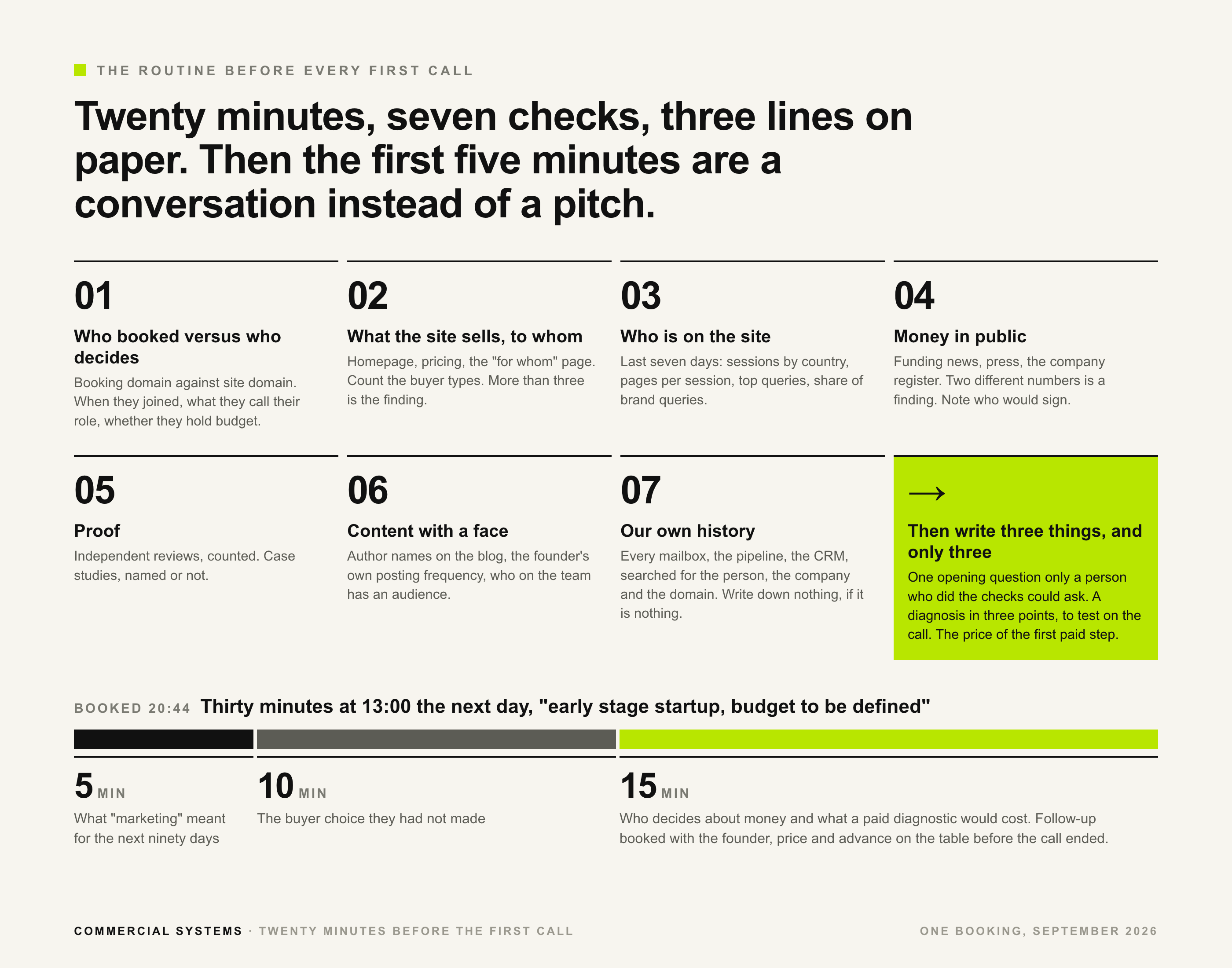
None of that took special access. It took twenty minutes and a routine I have run before first calls for a couple of years now. This piece is that routine, and the checklist at the end is the version we use internally, cleaned up so you can run it yourself.
Why the first five minutes are the whole call
Everyone knows the shape of a first call. They tell you about their business, you ask some questions, you describe what you do, and somebody says "let us set up a follow-up". Thirty minutes are gone, and the only thing either side learned is whether the other person seemed reasonable.
I stopped running first calls like that because the first five minutes decide most of what follows, and the standard shape wastes them. Open with "tell me about the business" and the prospect gives you the version that is on the website, which you could have read yourself. Open with a question that shows you read the website and noticed something specific, and they usually skip the pitch and start talking about the actual problem, because they can tell you would see through the pitch anyway.
So the twenty minutes are there to earn the right to skip the pitch. Everything I check feeds one opening question that only somebody who did the checking could ask.
For the call above, the opening question was: "You wrote marketing on the form. What do you mean by that for the next ninety days?" I asked it because the checking had shown me a corporate blog with nobody's name on it, a founder who did not post, a product sold to eight different buyer types at once, and a person on the call who was posting, on their own profile, exactly the kind of content the company was missing. "Marketing" meant something specific to them, and I wanted them to say it so we could get to the disagreement fast.
What I check, in the order I check it
The order matters, because the early checks change what the later ones mean.
First comes the gap between who booked and who decides. The booking email was from one company's domain and the website belonged to another company. That flag is common. The person on the call is a partner, an advisor, a fractional something, a head of marketing three months in, and the money sits with someone who will not be in the room. I check the person's own profile, the company's team page, and the date they appeared together. In this case the person had announced the role on their profile a few weeks earlier, and the company's site did not list them at all. So my first question on money was always going to be "who decides", and I expected the call to be an anteroom, with the real conversation happening later on a second call with the founder.
Second is what the site says it sells and to whom. I read the homepage, the pricing page and whatever page is closest to "who is this for", and I count buyer types. A company that lists consultants, startups, agencies, marketing teams, operations, support, product teams and enterprise as its customers has not chosen a customer, and everything else in the commercial machine will be built on top of that non-choice. I do not say it on the call in those words. I steer the conversation toward it, because in my experience it is usually the real problem under the one they booked about.
Third is who is actually on the site. For a client with Analytics and Search Console access I look at the last seven days: sessions by country, pages per session, top queries, and whether the brand name is the only thing anyone searches for. For a prospect I have none of that, so I use third-party estimators, and mostly I want to know whether there is anything to measure at all. Below a certain volume every estimator is guessing, so I treat "below threshold" as a finding in itself. For this call the estimate was tiny, mostly from two countries outside the target markets, with pages per visit barely above one. Whatever the deck says, that site is not a sales channel yet, and any conversation about paid traffic would be premature.
Fourth is money signals in public: funding announcements, press, the company register. This is where the two sets of numbers showed up, from two outlets a month apart, with no investor named in either. It is also where I found that the contracting party would be a local entity instead of the LLC on the letterhead, which changes the contract we would write and the law it would sit under. If the company has raised or is raising, I want to know whether "we will pay from the round" is going to be the answer to the first invoice, because that decides whether we ask for an advance. In that situation we always ask. The check just tells me to expect the conversation.
Fifth is proof. I go through every review platform where the category gets reviewed and count independent reviews. Zero is a finding. So are case studies on the site that are anonymous or written by the founder. When all the proof is self-reported, the sales process tends to hit a wall at the first serious buyer, and that wall is often where we end up doing the work. It also tells me not to repeat any of their claims back to them as fact on the call.
Sixth is their own content, and whether it has a face. A corporate blog with no author, a company page posting in a corporate voice with six hashtags, a founder who does not post. I see that pattern all the time, and it usually means the fastest lever available is a person who already has an audience talking about the product in their own voice. On this call the person who booked was that lever and did not seem to know it.
Seventh, and this is the one people skip, is our own history with them. Every mailbox we have, searched for the name, the company and the domain, then the pipeline and the CRM the same way. Here the answer was clean. I had greeted them once on a professional network in July after a profile visit, they had shared one company post the day before booking, and that was all. There was no referral, despite the polite sentence on the form. Knowing that saved me from opening with "so who put you in touch", which I would have asked, and which would have started the call on a small embarrassment for both of us.
What the twenty minutes changed
Without the routine, I would have opened with "tell me about the company". They would have given me the eight-buyer-type pitch with the funding number they preferred. I would have asked about marketing, they would have said posts and events, and I would have spent the remaining twenty minutes explaining why events reach investors more than customers when a customer is worth about a thousand dollars a year. Then we would have set up a follow-up with the same person, who could not sign anything.
With the routine, the first five minutes went to what "marketing" meant to them, the next ten to the buyer choice they had not made, and the last fifteen to who decides about money and what a paid diagnostic would cost. The follow-up was booked with the founder. The price of the audit was on the table before the call ended, together with the fact that we would want an advance. The only thing that changed between those two versions of the call was twenty minutes of checking.
The routine does not turn every prospect into a client. Most checks produce reasons to be careful, and some produce reasons to say no before the call. What it does is let the first call start roughly where a normal engagement starts after a week of getting to know each other. For a company that charges for diagnosis, that week is the most expensive thing we give away, and the routine is how we stopped giving it away.
The part I do not do
I do not build a proposal before a first call. The checking produces a diagnosis with maybe three points in it, and the call is where that diagnosis gets tested against what the prospect actually says. A proposal built before the call is built on the website, and the website is the least honest document a company produces.
I also do not send the prep to the prospect or read it out on the call. It shapes my questions, and that is all it does. The prospect meets a person who seems to have thought about them, which is true, and who asks unusually direct questions. The moment the prep becomes visible it turns into a performance, and the whole point of it is the opposite.
And I do not skip it because the call looks small. The booking that started this piece said "early stage startup, budget to be defined", the kind of booking a lot of people would take cold or not take at all. The twenty minutes let me take it seriously without spending a week on it.