


A UK construction founder posted this week that he was looking for a new marketing agency. Not a soft “open to recommendations.” A public, irritated, serious enquiry, because the last agency had taken 13,000 pounds off him for SEO and delivered zero leads. Not a few weak ones. Zero.
Then he set the bar, and it was the clearest brief I have read in a long time:
Proven results in his industry.
Agreed targets in the contract. Leads and enquiries, not impressions.
Accountability if the targets are missed.
The comments filled with agencies. And almost every one of them did the same thing. The moment he said the word “targets,” they went vague.
“It depends on so many factors.”
“SEO is a long game.”
“You can’t really attribute leads cleanly.”
“Let’s hop on a call about your goals.”
All true, technically. All also the sound of a business model backing away from a measuring tape.
Here is what that founder understood in his bones, because he builds things for a living.
He prices a job. He builds the roof. He gets paid for the roof. He cannot turn to a client and say “sorry, I tried, but you have not got walls or a roof yet, let us adjust the plan and try again for another 10k next year.” If he did that, he would be out of business by spring. In his world, you are paid for the delivered thing, not the effort that surrounded it.
So when he looks at marketing and hears “we cannot really promise outcomes,” he is not being difficult. He is being correct. He is applying the only standard he has ever been allowed to work under, and noticing that a whole industry has quietly exempted itself from it.
This is the line that runs under everything I build, so let me say it plainly.
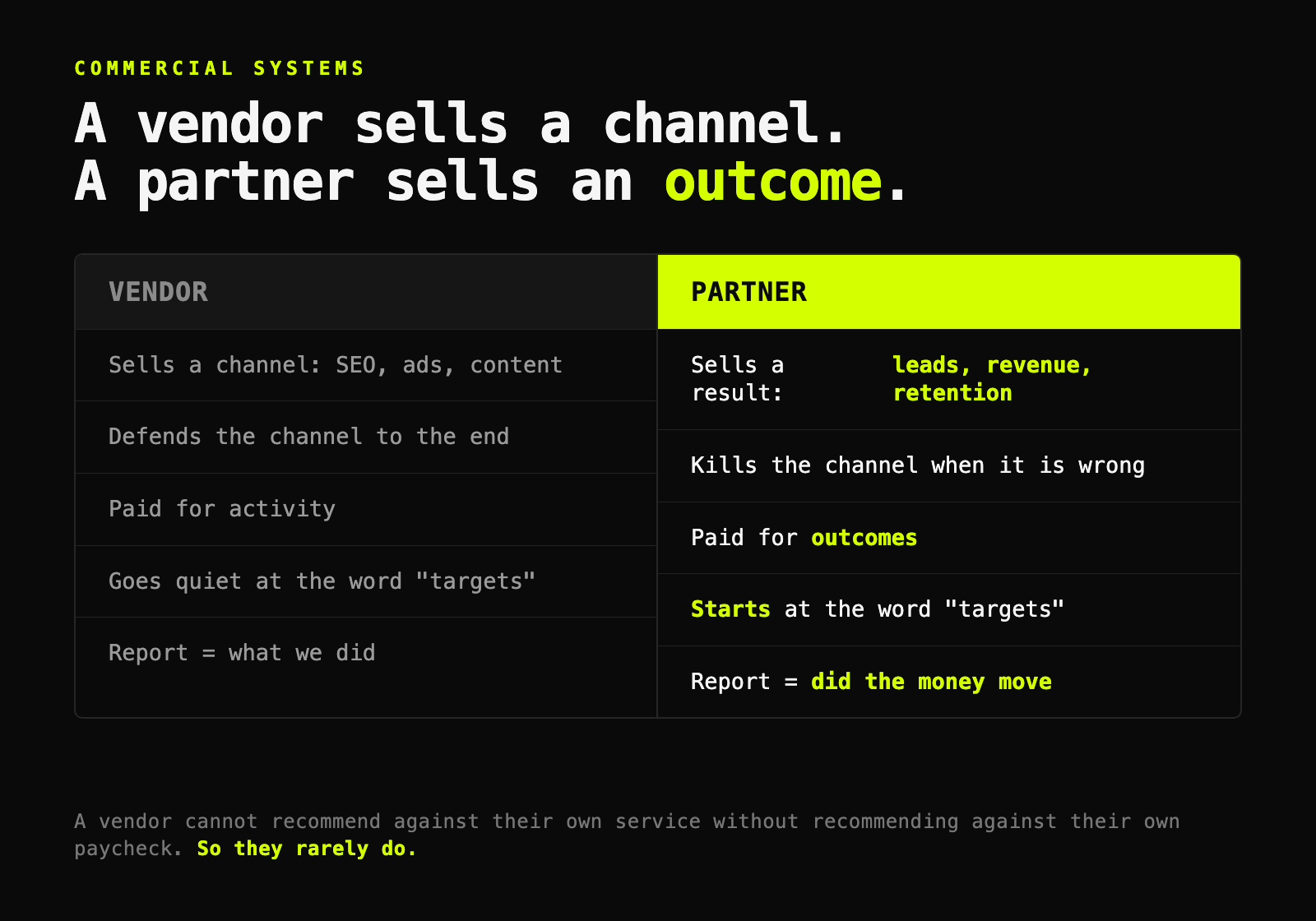
A vendor sells you a channel. A partner sells you an outcome.
A vendor sells SEO, or ads, or content, or “social.” And a vendor will defend that channel to the last breath, because the channel is the invoice.
If the channel stops working, the vendor’s job quietly becomes convincing you it still works, or that it needs more time, or more budget. A vendor cannot recommend against their own service without recommending against their own paycheck. So they rarely do.
A partner sells you a result. Leads. Revenue. Retention. And because the result is the product, every channel, including the partner’s own, becomes a lever with a right time and a wrong time to pull. That one shift changes what the partner is willing to say out loud.
Let me show you what it looks like from the inside, because for us it is not a slogan. It costs money.
We once told a client to turn off a service we were billing them for. Their ads were not underperforming because of the ads. The company had gone through a domain change, and their search authority was split across the old and the new domain. The foundation was cracked. Pouring paid traffic onto that is renting attention for a house with no floor. The honest call was: switch this off, fix the foundation, bring paid back when there is something solid for it to amplify.
The line item with our name on it went to zero for a while. On purpose.
Another client had campaigns that were genuinely working. Good cost per result, improving week over week. We told them to slow down. Not because the ads were bad, but because the thing on the other side of the click was not finished. New visitors were about to land on gaps and quietly leave, and we would have been paying, per click, to manufacture disappointed first impressions at scale.
So the budget waited. Not cancelled. Waited.
Neither of those decisions goes in a case study. Both cost us revenue in the short term. And both are the entire reason those clients stopped asking whether our advice was self-serving. You find out which kind of firm you hired the day one of their own services stops making sense, and they are the ones who tell you.
Here is the mechanism underneath, and why the vagueness is so predictable.
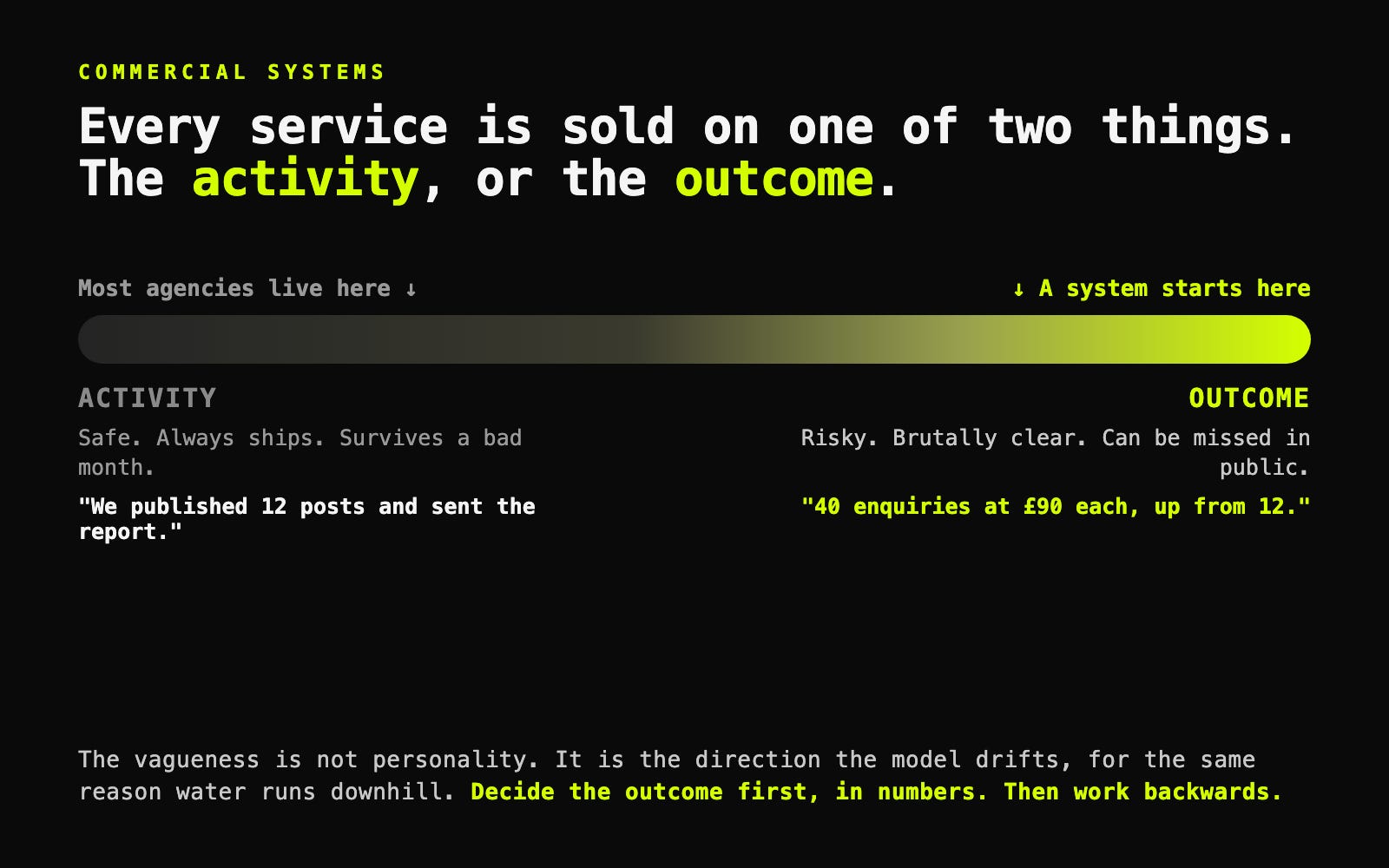
Every service can be sold on two things: the activity, or the outcome. Activity is safe and nearly impossible to fail at.
“We published twelve posts, ran the campaigns, sent the report.”
All true, all delivered, all measurable in the most useless way. Outcome is risky and brutally clear.
“You got 40 qualified enquiries at 90 pounds each, up from 12.”
One of those sentences can be missed in public. The other cannot.
Agencies drift toward activity for the same reason water runs downhill.
Activity always ships.
Activity survives a bad month.
Activity lets you send a confident report full of graphs while the phone stays silent.
That founder had three quarters of exactly that: big on graphs, short on calls.
A commercial system starts at the other end. You decide the outcome first, in numbers, then you work backwards to the activity that earns it, and you write the number down where both sides can see it.
Positioning, marketing, sales, and customer success stop being four departments filing four reports and become one machine measured on one question: did the money move.
That is the whole difference between buying marketing and building a system. Marketing is a set of activities you rent. A system is an outcome you own, with the levers arranged behind it.
So if you are that founder, or any founder about to sit across from your next agency, here is the question that does the sorting for you. It is short, and it is not hostile.
“Will you put the lead number in the contract, and will you tell me, in writing, when I should stop paying you?”
Watch what happens to the room. Half your shortlist will start explaining why that is not really possible. That half just sorted itself out for you. The ones still sitting there are the ones worth building with.
The builder priced this correctly in his head before a single agency replied. Most founders do. They know exactly what a result is worth, and exactly what “I tried” is worth, because they live under that standard every day inside their own business. The gap was never the founders. The gap is an industry that has spent years teaching itself to go quiet at the word targets.
Stop hiring the quiet.
Commercial Systems is written by Nemanja Zivkovic, Strategy Director and Senior Partner at Funky Enterprises. We build commercial systems for B2B companies: positioning, marketing, sales, and customer success as one machine measured on outcomes.
Want to see where your own system leaks money before an agency ever touches it?
Run the Commercial System Leak Audit (2 minutes, direction not diagnosis): https://claude.ai/code/artifact/6f9ae569-1155-4a63-a99d-23b10abeee7e.
And if a friend still measures marketing in posts published, forward them this.